What Is a Swap in Forex? Overnight Costs Explained
A swap, also called rollover or overnight financing, is the interest debited from or credited to your account for holding a position past the broker's daily rollover time. It exists because every forex trade borrows one currency to buy another, so you pay the interest rate on the one you are short and earn it on the one you are long. Hold a position for an afternoon and swap is irrelevant; hold it for three months and it can outweigh the trade.
How it works
The raw driver is the difference between the interest rates of the two currencies in the pair, adjusted by the broker's own markup, then divided across the year and applied to your position size.
Nightly swap ≈ Position size × (Rate differential − Broker markup) / 365
In practice brokers do not publish it as a rate. They publish a swap long and a swap short figure per lot, in points or in account currency, in the contract specification for each symbol. You are charged whichever side you hold, once per night, at rollover, typically 21:00 or 22:00 UTC depending on the broker's server time.
Triple swap Wednesday is not a penalty. Spot FX settles two business days forward, so a position held through Wednesday night settles on Monday and carries three days of financing, charged in one go. Some brokers apply the triple charge on Friday instead for metals, indices and CFDs, which is why the day matters and the rule is not universal.
Positive carry is real but narrow. Being long the higher-yielding currency can earn swap rather than pay it, which is the mechanism behind carry trades. The broker's markup is applied to both sides, so on many pairs both directions are negative, and the pair where carry is genuinely positive is usually the pair where the currency is falling.
Why it matters
Swap is the cost that punishes holding, and specifically punishes holding losers. A grid or martingale system that refuses to close underwater positions pays financing on those positions every single night for as long as it holds them, so the cost grows in step with the mistake. The equity curve looks flat while the account bleeds.
It also changes what a strategy is. A system with a positive edge over two days can be net negative over two weeks purely on financing, without a single new losing trade.
What the data shows
Across the public accounts on ShowMyTrades with trading history (August 2026), $862,547 has been paid in swap. Of the accounts with any swap activity at all, 86.3% pay net negative swap: earning carry is the exception, not a plan.
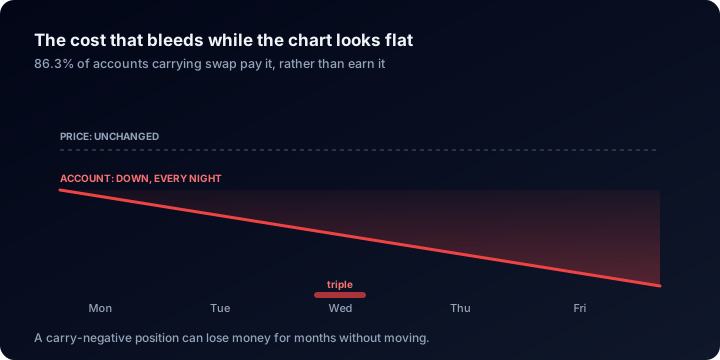
Financing accrues on time held, not on trades taken: the chart can stay flat while the balance sinks.
What makes that total striking is how short the typical holding period is. The median trade on those accounts lasts 2.4 hours, and the median account has 171 closed trades. Most accounts here barely touch rollover, and swap still amounts to roughly 18% of the $4,782,670 paid in commissions, which suggests the bill is concentrated on the minority of accounts that hold.
Where you see it on ShowMyTrades
- Total Swap Paid sits in the Advanced Statistics panel, next to Total Commissions. It is coloured red when the account is net negative on financing and green when it is net positive, so the direction is readable at a glance.
- The Closed Trades table under Trade History & Balance Progression has a Swap column per ticket, alongside Commission. Note that the profit column is labelled Profit (Gross): the financing is shown separately, not folded in.
- Custom Analysis carries a toggle, Include swaps in profit calculations. Switch it on and off and the difference in the resulting statistics is exactly what the broker's financing did to the record.
- Avg. Trade Length in Advanced Statistics tells you whether swap should matter for that account before you even look at the figure. A two-hour average and a large swap bill do not belong together.
Common misunderstandings
- Swap is not a service fee. It is financing, and it can be paid to you. The broker's markup is the fee, and it is applied in both directions.
- Triple swap is a settlement convention, not a charge for trading on Wednesday. Closing before rollover avoids it entirely.
- Carry is not free money. The interest differential is small relative to the currency move that typically erases it, and leverage magnifies the move far more than the carry.
- A flat chart is not a costless month. Financing on open positions accrues whether or not any trade closes.
For how swap fits alongside spread and the rest of the metrics on a public account, read the guide to tracking trading performance.
Related terms
Interest Rates
Central bank interest rates set the rate differential between two currencies, which becomes the swap you pay or earn every night you hold a position open.
Spread
A spread is the gap between the bid and ask price, the cost you pay to enter a trade. Here is how it works, what it costs per lot, and why brokers differ.
Leverage
Leverage is the ratio between position size and the capital backing it. Here is the margin formula, a worked example, and drawdown data from thousands of accounts.
Slippage
Slippage is the difference between the price you expected and the price you got. Why it is worst when it hurts most, and how latency makes it measurable.