Swap and the Carry Trade: The Cost That Bleeds While the Chart Looks Flat 2026

🌙 "The Strategy Works, the Account Doesn't"
You backtest a system. It holds positions for four or five days. The backtest is comfortably profitable. You run it live for eight months and the equity curve is flat.
The trades are right. The entries match. The exits match. Nothing is broken. The money left through a line most traders never look at: swap.
Swap is the interest you pay, or receive, for keeping a leveraged position open past the daily rollover. It never appears on a chart. It shows up as a small negative number attached to each trade, and on a strategy that holds for days it compounds into the difference between a business and a hobby.
Across the public accounts on ShowMyTrades with trading history, $862,547 has been paid in swap (August 2026). Nobody screenshots that number. This guide is about how to read it, how to price it before you enter, and why positive carry is rarer than the strategy blogs suggest.
💤 What a Swap Actually Is, and Why Wednesday Costs Triple
When you buy EUR/USD you are, mechanically, borrowing dollars and holding euros. Spot FX settles two business days forward. If you keep the position past the broker's rollover, the settlement date has to be pushed forward another day, and that roll is priced using the interest rate differential between the two currencies.
Three things follow, and all three matter:
- Only open positions are charged. Close before rollover and swap is zero, no matter how big the position was. This is why intraday systems are structurally immune to it.
- The charge is per lot, per night, not per trade. Ten lots for one night costs the same as one lot for ten nights.
- The rate is set by your broker, not by the market. The interest differential is the raw material; what you actually get is that differential with the broker's markup subtracted, on both sides.
The rollover happens at the broker's daily cutoff, typically 17:00 New York time, which is midnight on most MT4 and MT5 servers. MT5 brokers may express the swap in points, in the account currency, or as an annual percentage: the contract specification for each symbol tells you which.
Then there is the night everybody notices. A position rolled on Wednesday settles on Monday rather than on Saturday, because the weekend holds no settlement days, so three nights of financing are charged at once. That is triple swap Wednesday, and it is not a fine: it is the weekend arriving early. Which makes the arithmetic simpler than most people expect:
Over a full week you pay for seven nights of financing, not five. A position held 30 calendar days pays roughly 30 nights of swap, however many Wednesdays it crossed.
Two caveats before you build anything on that rule. Some brokers apply the triple charge on Friday for metals, indices and other CFDs rather than on Wednesday, and every instrument follows its own settlement conventions: do not assume the FX rule applies to gold, oil or a stock index. The contract specification for the symbol settles both questions.
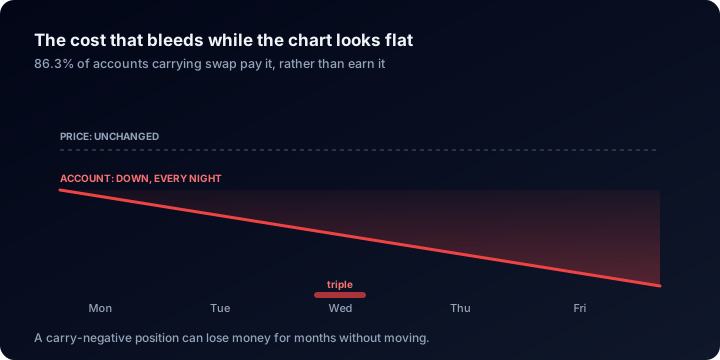
Seven nights of financing come out of a five-day week, whatever the chart does.
⚖️ Positive Carry Is Rarer Than the Blogs Suggest
The classic carry trade is simple: go long the high-yield currency, short the low-yield one, collect the differential every night, and treat the exchange rate as noise you will survive.
The mechanism is real. What the strategy write-ups usually omit is that the retail version is priced against you on both sides:
| Long the higher-yielding currency | Short the higher-yielding currency | |
|---|---|---|
| Interest differential | In your favour | Against you |
| Broker markup | Subtracted from your credit | Added to your debit |
| What lands in the account | A small positive, or zero | A clear negative |
Add the long swap and the short swap on almost any pair at almost any broker and the sum is negative. That gap is the broker's cut, and it is charged whichever way you face. Which is why, across the public accounts on ShowMyTrades that show any swap activity at all, 86.3% pay net negative swap (August 2026). Fewer than one in seven breaks even or better on financing.
That does not make positive carry impossible. It makes it a claim to verify rather than a premise to build on: read both swap figures for your symbol, at your broker, before the strategy assumes an income line that may not exist.
🧮 How to Compute What a Position Costs You Per Night
Do this before you enter, not after you exit. Take the swap rate for your symbol from the contract specification, then:
Nightly cost = swap points per lot × value of one point at your lot size × lots
If your broker quotes the swap in points, you need the value of a point in your account currency: that is exactly what the pip calculator returns; divide by ten for a point on a 5-digit quote. If the swap is already quoted in account currency per lot, skip straight to the multiplication.
Here is what the arithmetic looks like for a position costing $7.40 per lot per night. Plug your own broker's number in; the shape does not change.
| Holding period | Nights charged | 1 lot | 5 lots |
|---|---|---|---|
| Overnight | 1 | -$7.40 | -$37 |
| One week | 7 | -$51.80 | -$259 |
| One month | 30 | -$222 | -$1,110 |
| One year | 365 | -$2,701 | -$13,505 |
Now put it against an account size, the only form in which the number means anything. One lot held for a month on a $10,000 account is 2.2% of the account, gone, before the trade has been right or wrong about anything. Held for a year it is 27%.
Set that against what the population actually earns. The median time-weighted return across the public accounts on ShowMyTrades with trading history is +3.2%. A financing cost of 2.2% a month is not a rounding error against a number that size.
The position size calculator sets the lot size your risk budget allows, and the rebate calculator shows what cashback claws back on the commission side, full set in the calculators guide.
📉 What This Does to a Long-Hold Strategy
Most accounts never meet this problem. The median average trade length across the public accounts on ShowMyTrades is 2.4 hours: the typical account closes in the same session it opens, and swap is structurally irrelevant to it.
The problem belongs to a specific population: grid systems that sit on hedged baskets for weeks, "set and forget" swing EAs, martingale recovery legs held while waiting for a retrace, and anything that averages down. These are precisely the strategies that look smoothest on the chart, because their losses are unrealised. Their swap is not unrealised. It is deducted every night, in cash.
The failure mode is worth naming. A basket sits open for six weeks. The balance line barely moves and the monthly returns table shows small green cells. Then the basket closes and the realised result is far worse than the price action implied, because six weeks of financing on every leg came out along the way, one small debit at a time, none of them large enough to investigate.
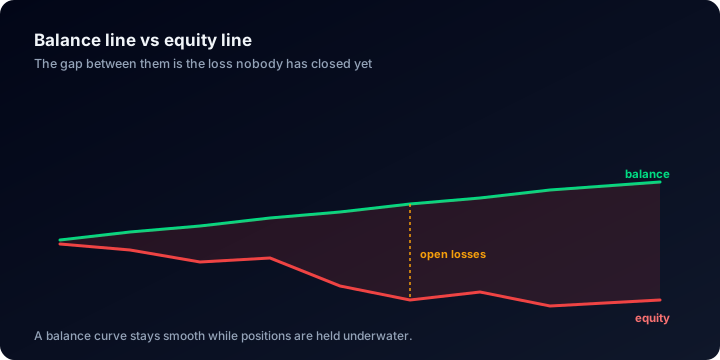
The basket that keeps a loss off the balance line is the same basket paying financing every night it stays open.
Averaging down makes it worse twice over: doubling the position doubles the nightly cost and extends the hold, because a bigger position takes longer to be right. For the strategy-level view of which numbers to follow over time, the performance tracking guide covers what to watch and how often.
🔍 Where Swap Shows Up on a ShowMyTrades Account Page
Swap appears on the page in four places, each answering a different question.
| Where | What you get | The question it answers |
|---|---|---|
| Advanced Statistics → Total Swap Paid | The lifetime figure, signed and coloured | Has this account been a net payer or a net receiver? |
| Trades table → Swap column | Per-trade swap, alongside Duration and Commission | Which trades did the damage? |
| Trades table → open positions total row | Swap accumulated so far on positions still open | What is the current book already costing? |
| Custom Analysis → "Include swaps in profit calculations" | The same statistics recomputed with swap stripped out | How much of the result is trading, and how much is financing? |
Three practical notes.
The Swap column is off by default. Open the Display menu at the top of the trades table and switch it on together with Duration: those two side by side are the whole story. The choice is stored in your browser, so it survives to the next visit.
Total Swap Paid is displayed with its sign, green when the account is a net receiver and red when it is a net payer. If that figure is deep red on an account described as intraday, the description does not match the trades.
The Custom Analysis slideover turns observation into measurement. Set Trade Duration (seconds) with a minimum of 86400 to isolate everything held longer than a day, run it, then untick Include swaps in profit calculations and run it again. The gap between the two profit figures is what financing cost that part of the system. On your own account in the dashboard that filter set saves as a preset, so next month's check is one click; on someone else's public page the filters run live but are not saved.
If any of these modules are unfamiliar, the module-by-module walkthrough of an account page covers all of them in order.
🕌 Swap-Free Accounts, Factually
Swap-free accounts, also called Islamic accounts, set the overnight interest charge to zero for religious compliance. They are widely offered and widely misunderstood. What is generally true, with every detail set per broker and per entity:
- Zero swap is usually not zero cost. Brokers commonly replace it with a flat administration or holding fee per lot per night, often after a grace period of a few days.
- Coverage is partial. Swap-free frequently applies to majors and metals only; exotics, indices and crypto CFDs often keep normal financing.
- Eligibility can be revoked. Several brokers reserve the right to withdraw the status from accounts that use it to run permanent overnight books.
- The cost moves, it does not disappear. When the holding fee is booked as a commission rather than as swap, it leaves Total Swap Paid and lands in Total Commissions. Read the two lines together or you will conclude the account trades for free.
Whatever the arrangement, the account page reports what the broker actually charged, because the figures arrive through the broker connection: the read-only investor password on MT4 and MT5, the platform's own API on cTrader and TradeLocker, rather than being typed in by the owner. That is the difference between a record and a claim, which is the subject of verified vs unverified track records.
⚠️ Five Ways Traders Misread Swap
- Reading gross profit and calling it performance. The trades table can show Profit (Gross) as its own column; the net figure is gross plus swap plus commission. A system with a thin edge can be positive gross and negative net, and the difference belongs to the broker.
- Assuming the short side pays. "If long costs, short must earn" is false on most pairs, because the markup is taken out of both directions. Check both numbers in the contract specification first.
- Backtesting without financing. Backtests routinely ignore swap, or apply today's rate across a five-year history. Rates move with central bank policy; a carry that paid through one cycle can invert in the next.
- Forgetting the triple day when sizing. A position opened Wednesday afternoon and closed Thursday morning costs three nights, not one. On a short hold that is the whole expected profit.
- Treating swap as too small to matter. It is small per night and large per quarter. 53.9% of the public accounts on ShowMyTrades are more than 90% automated, and an EA does not notice a $7 nightly charge the way a human watching the terminal would.
❓ FAQ
Is swap charged on positions closed the same day? No. Swap applies only to positions open at the rollover, typically 17:00 New York. Close before it and you pay nothing, whatever the size.
Why is swap negative on both the long and the short side of the same pair? Because the broker's markup is subtracted from both sides of the interest differential. On pairs with a small rate gap, that markup is larger than the gap itself, so both directions end up negative.
Does swap affect Gain, or only Abs. Gain? Both. Gain on the account page is the time-weighted return, and swap is a real cash movement, so it lands in equity and therefore in that figure. It is a cost, not a funding event: unlike a deposit or a withdrawal it is never neutralised.
Can I see how much swap cost me on one specific strategy? Yes. Use the Custom Analysis slideover: filter by magic number or by trade comment to isolate the EA, then compare the result with Include swaps in profit calculations ticked and unticked.
Are swap-free accounts actually free? Usually not. Brokers commonly charge a flat holding fee per lot per night after a grace period, and that fee often appears under commissions rather than swap. Compare the total cost per lot, not the label on it.
Someone is showing me a long-hold track record. What should I check? Total Swap Paid against total profit, and average trade length against the claimed strategy. If a "swing" record shows no swap at all, the trades are not being held overnight. The full checklist is in how to verify performance claims.
🔗 Related Guides
- How to read a trading account dashboard: every metric on the page, including the cost block, explained in order
- The complete guide to tracking trading performance: which numbers to watch monthly so costs never surprise you
- How to verify trading performance claims: the forensic checklist before you fund, follow or buy anything
- The forex calculators guide: pip value, position size and the rest of the arithmetic this page assumes
See it on real accounts. Every page linked from Explore is broker-synced, and Total Swap Paid sits in Advanced Statistics on every one that leaves the block visible, including the accounts where it is the largest number on the page.
Connect your account free and find out what your own holds have been costing you every night.
Cost Percentage: How Much of Your Gross Profit the Broker Keeps {YEAR}
Commissions and swap come out of your gross profit, not out of thin air. Compute the ratio from four fields on your account page and see what the broker keeps.
Volume Analysis: What Your Lot Sizes Say About Your Risk {YEAR}
Lot size is the one number you choose before the market decides anything. Read it as a risk fingerprint: martingale signatures, fixed-lot drift, sizing done right.