What Is a Stop Loss? Types, Limits and Real Numbers
A stop loss is an order placed in advance to close a position at a specified price, capping the loss on that trade. It is a decision made before the trade is open and handed to the broker's server, which is the entire point: it removes the exit from the moment when you will least want to take it. It caps intent, not outcome: the fill can be worse than the level.
How it works
Four variants cover almost everything in use.
- Fixed stop. A price level attached at entry and held on the broker's server. It survives a power cut, a crashed terminal and a lost connection, because it does not live on your machine.
- Trailing stop. Follows price in the profitable direction and never moves back. It locks in gains and also turns winners into break-even trades in noisy markets. In MetaTrader the built-in version is managed by the terminal, so it only works while the platform runs, which is why EAs trail by modifying the server-side stop instead.
- Volatility-based stop. Distance derived from current range, typically an ATR multiple, rather than a round number. The same 20-pip stop on EUR/USD and on gold is not the same risk.
- Time stop. Exit after N hours or bars regardless of price. Rare, and underused.
Sizing follows from the stop, not the other way round:
Position size = (Equity × Risk %) ÷ (Stop distance in pips × Pip value)
Choosing a lot size first and then hunting for a stop that fits the margin is the most common way an account acquires an unbounded loss. The position size calculator runs it in the correct order.
Why it matters
A stop loss is a trigger, not a price guarantee. Once the level trades, the order becomes a market order and fills at the next available price. In a gap (a Monday reopen, a rate surprise, the Swiss franc in January 2015) that price can be a long way past the level. The difference is slippage, and it has no ceiling. Only a guaranteed stop loss, sold by some brokers for a fee, fills at the stated price.
The deeper function is behavioural. Without a pre-committed exit, the decision to close a loser is taken while holding it: the worst possible moment. Everything downstream (profit factor, drawdown, whether a margin call ever arrives) is decided there.
What the data shows
Across the public accounts on ShowMyTrades with trading history (August 2026), the median win rate is 68.8% and the median profit factor is 1.28. These describe accounts published here, not traders in general.
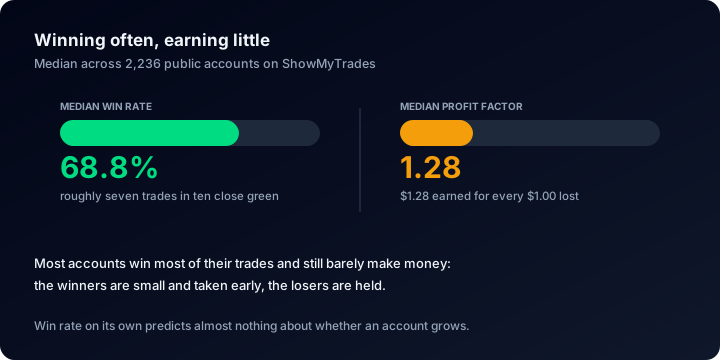
Winning often and earning little is the pattern a pre-committed exit exists to break.
Read them together, because separately each one flatters. Nearly seven trades in ten close green, yet gross profit is only 1.28 times gross loss. Both hold at once only if losers are substantially larger than winners: at a 68.8% win rate, a 1.28 profit factor implies an average loss roughly 1.7 times the average win. (Two medians of two distributions: an illustration, not one measured account, though the direction is not in doubt.)
That is the signature of taking profits early and letting losses run, and it is the pattern a stop loss exists to prevent. It surfaces again in the median Sharpe ratio of 0.05: return per unit of volatility barely above zero. The median account closes 171 trades, so this is not a thin sample.
Nor is it hand-made. Median autotrading share is 99%, and 53.9% of these accounts run above 90% automation. A missing stop loss there is a missing line of code, applied identically to every trade the system takes.
Where you see it on ShowMyTrades
- The trades table has an S/L column showing the stop price recorded on each position, marked in red when the trade was actually closed by it. Hundreds of rows with an empty S/L column means the account trades without pre-committed exits.
- Avg. Win and Avg. Loss in the advanced statistics. If Avg. Loss is a multiple of Avg. Win, stops are either absent or being moved.
- Worst Trade (P&L) and Worst Trade (Pips). The largest single loss the account has taken is the real stop loss, whatever the description claims.
- Expectancy, shown in pips and account currency, is the per-trade average once wins and losses are combined: the number a high win rate cannot flatter.
- Avg. Trade Length, in the same block, exposes the asymmetry: losers that last days and winners that last minutes.
Common misunderstandings
- "A stop loss guarantees my maximum loss." It caps the trigger, not the fill. Gaps and thin books fill worse, sometimes far worse.
- "Wider stops are safer." A wider stop at the same lot size is a larger loss. Distance and size are one decision, not two: see position sizing.
- "Moving the stop gives the trade room." Moving a stop away from price converts a defined loss into an undefined one. This single habit produces the Avg. Loss to Avg. Win gap above.
- "My win rate is high enough that I do not need stops." Backwards. The median account here already wins 68.8% of its trades and still only reaches a 1.28 profit factor.
For what to watch on your own record over time, see the guide to tracking trading performance.
Related terms
Profit Factor
Profit factor is gross profit divided by gross loss. Below 1.0 an account loses by construction. Here are the bands and the 1.28 median across thousands of accounts.
Position Sizing
Position sizing turns a risk percentage into a lot size using your stop distance and pip value. The formula, the three common methods, and what bad sizing costs.
Slippage
Slippage is the difference between the price you expected and the price you got. Why it is worst when it hurts most, and how latency makes it measurable.