What Is Third-Party Verification in Trading?
Third-party verification is an arrangement where an independent platform reads trading results directly from the broker, over a path that carries data one way, so the published record has no step at which the trader could edit it. The trader supplies access, not data. That single distinction separates evidence from a claim, and it is the whole of what verification does.
How it works
The chain has three links and one rule.
broker server → independent read path → tracking platform → public page
                          ↑
              the trader can revoke this, but never edit it
The connection is not the same on every platform. On MetaTrader it is the investor password, a second credential the broker issues that can read balance, equity and full closed history but cannot open, modify or close a position, read-only by construction. On cTrader it is an OAuth2 authorisation granted through the trader's own cTrader ID, withdrawable whenever the trader chooses. On TradeLocker it is a REST connection whose credentials are held encrypted server-side and used only to read. What the three have in common is the part that matters: the record is read from the broker, and the trader has no step at which they can edit it.
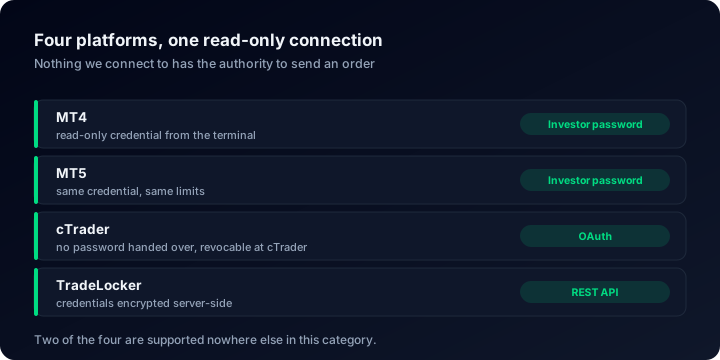
Different credentials, one property in common: none of them can send an order.
Two separate questions hide inside the phrase, and they need two separate answers. Whether the data is real is settled by the connection. Whether the publisher is the person who traded it is not: an investor password can be handed to anyone, so proving ownership requires an action only a full-access holder can perform inside the platform.
Why it matters
Everything downstream of the connection is arithmetic on the inputs. If the inputs are editable, the profit factor, the drawdown and the equity curve are decoration, however detailed the page looks. Screenshots, PDF statements and spreadsheets share one defect: they are produced by the party asking to be trusted.
What verification does not prove is equally definite. It says nothing about skill, nothing about whether the strategy survives the next regime, nothing about the other accounts the same person runs and did not publish, and nothing about whether the record is worth copying. It removes a specific set of lies from the table so that the uncertainty left over is honest uncertainty. That is a real service and a narrow one.
What the data shows
The figures below describe accounts published on ShowMyTrades, not traders in general. 10,000+ accounts are connected here (August 2026), resting on 15,436,464 synchronised trades across 703 distinct broker servers. That is the volume of data the question applies to.
Against it, 65 published accounts carry Track Record Verified and 264 carry Trading Privileges Verified. The distance between those two counts is the informative part: proving you can trade an account is a cheaper action than opening an independent read path into it, and it is the read path that decides whether the numbers are evidence. Roughly three published pages in a hundred carry that badge, so "where did this data come from" gets a different answer on almost every page you open.
Where you see it on ShowMyTrades
Which mechanism verified a page is written on the page itself. The Track Record badge in the account header carries a tooltip naming the path used for that account: the read-only investor password on MT4 and MT5, the cTrader Open API authorisation on cTrader. The Trading Privileges badge names its own: on MetaTrader, a pending order placed with the owner's ShowMyTrades user ID in the comment field, an action only a full-access holder can perform. Read both tooltips and you know which of the two questions above the page has answered.
Next to them, the Info group of the same header prints the platform, the broker with its trade server behind the tooltip, the account currency, the leverage and whether the account trades manually or automatically. None of that is typed in by the owner; it arrives with the feed, which makes it the quickest cross-check against whatever the page claims in words.
Everything below the header (Account Stats, the charts viewer, Monthly Returns, Advanced Statistics, the trades table) is arithmetic on that same feed, and the header travels with the Complete Dashboard widget, so an embed on someone else's site carries its provenance rather than borrowing the host's.
Common misunderstandings
- Read-only describes the data path, not your money. An investor password cannot place, modify or close an order, and a verified feed gives the platform no ability to trade the account it reads.
- Verification is a live state, not a stamp. Revoke the credential and the feed stops and the badge turns grey. It attests to a connection that is open now, not to a claim made once.
- The two badges answer different questions. Provenance and ownership are separate problems, and a page can settle one without settling the other: 264 against 65 is what that looks like at scale.
- Nothing about the strategy is certified. What remains after verification is genuine uncertainty about method, regime and sample size, and it is still the larger part of the decision.
The full treatment (what each badge establishes, and the four things neither can prove) is in what third-party verification actually proves.
Related terms
Verified Track Record
A verified track record is performance data pulled straight from the broker through a read-only link, continuously, with nothing the publisher can edit.
MT4 Investor Password
The MT4 investor password is a read-only credential: it shows balance, equity and every trade, but it cannot open, modify or close a position, or withdraw.
Copy Trading
Copy trading reproduces one account's orders on another. Here are the three sizing modes, and why your result never matches the source account exactly.
Myfxbook
Myfxbook is a forex analytics and community platform: traders connect an MT4 or MT5 account and it publishes the statistics on a public, shareable page.