What Third-Party Verification Actually Proves (And What It Does Not) 2026

🎯 The Question Behind the Badge
You are not really asking what "verified" means. You are asking whether this page is safe to act on.
A green badge is a compressed answer to that, and compression loses things. Two badges sit at the top of every ShowMyTrades account page, and they answer two questions people routinely merge into one: is this data real, and is this person the one who traded it.
Neither answers the question you actually care about: whether the next twelve months look like the last twelve. Nothing can. What verification does is take a specific set of lies off the table, so the uncertainty that remains is honest uncertainty.
This guide maps that boundary: where proof stops and judgement starts. For the button-by-button steps, see how to verify your trading account; this one explains what they buy you.
🪪 Two Badges, Two Different Questions
Start with something that surprises people: no account on ShowMyTrades gets its numbers from a form. Every trade on every page was machine-read from the platform: no upload button, no CSV, no field for typing a gain percentage.
So what does Track Record Verified add? Independence. A read-only broker credential is attached, so the record can be read straight from the broker rather than only through software running on the trader's own computer. The data path stops being something the account owner hosts.
Trading Privileges Verified answers a different question. The publisher demonstrated full access to the account by performing an action inside the platform that only a full-access holder could perform. Not "are these trades real" but "are they this person's trades".
| 🛡️ Track Record Verified | 🔑 Trading Privileges Verified | |
|---|---|---|
| The question | Where does the data come from? | Who is publishing it? |
| What it establishes | A read-only broker credential is on file, so the account can be read directly from the broker | The publisher holds full access to the account |
| MT4 / MT5 | A read-only investor password saved on the account | An action in the terminal only a full-access holder can execute |
| cTrader / TradeLocker | Granted by the connection itself: the account holder authorised it | Same event: the connection cannot exist without the owner's credentials |
| Cannot tell you | Whether the publisher is the trader | Whether any of it is worth copying |
Each badge alone leaves a hole the other fills. Real data published by someone who did not trade it is a misrepresentation; proven ownership of an account whose data path nobody can check independently is still a claim.
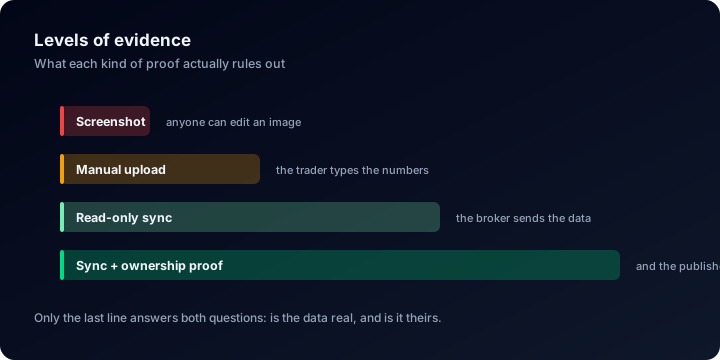
Only the top rung answers both questions at once; every level below it leaves one of them open.
🔑 What a Read-Only Password Can and Cannot Do
On MT4 and MT5 the mechanism is the investor password: a second password the broker issues alongside the master one. The asymmetry between them is the entire reason third-party verification is possible.
It can: read balance, equity, open positions, full closed history, leverage, currency, and whether the account is real or demo.
It cannot: open, modify or close a position, change settings, deposit, withdraw, or change the master password. It is a window, not a door, which is why handing one to a third party is reasonable, and why any platform demanding trading access to prove a record deserves none.
Two honest limits:
- It reads one account. The credential belongs to one account number at one broker. It says nothing about the other accounts the same person runs, the failure mode covered below.
- It is revocable. Rotate it at the broker without updating it here and the direct connection stops. Not a hole in the design: a record that goes quiet during a bad month leaves a gap and a stale Last change timestamp. Silence has a date on it.
cTrader reaches the same place by another route: OAuth2 through the trader's own cTrader ID, which grants both badges at connection time because it could not have happened without the owner. TradeLocker connects over REST with the owner's credentials, encrypted server-side.
🔄 One Import Proves Nothing. Continuous Sync Proves Something.
A one-off import is a photograph of a moment the uploader chose. Continuous synchronisation is a recording nobody chose.
The difference is about who controls the sample. With an import the trader picks the date; with a live connection the platform reads whatever is there, including the week they would rather skip.
| One-off import or screenshot | Continuous synchronisation | |
|---|---|---|
| Who picks the moment | The publisher | Nobody |
| Losing periods | Can be cropped | Appear as they happen |
| A pause in trading | Invisible | A gap and a stale Last change |
| Rewriting the past | Trivial | Not an available operation |
So a live connection establishes what an import never can: losses shown as they happened rather than after they were survived, gaps that stay visible, and history that only accumulates.
For scale: 15,436,464 trades synchronised from 10,000+ connected accounts across 703 broker servers (ShowMyTrades, August 2026). The median public account holds 171 closed trades, median trade length 2.4 hours. Records like that are built one trade at a time, not one upload at a time, which is what makes them awkward to curate.
🚧 The Four Things Verification Still Does Not Prove
| ✅ Verification establishes | ❌ Verification says nothing about |
|---|---|
| These trades happened, at this broker, at these times | Whether they will keep happening |
| The publisher controls this account | Whether this is the only account they run |
| Real or demo, taken from the account's trade mode | Whether the strategy stays the same next month |
| The commissions and swap actually charged | What software or method produced the trades |
1. That it will keep working. Both badges describe the past. Across the public ShowMyTrades accounts with trading history, 63.0% show a positive time-weighted return, median +3.2%. A positive record is common; a durable one is a different animal, and no badge separates them.
2. That the strategy will stay the same. A verified account can change parameters, instruments, risk per trade or even hands, with no announcement. Watch for the fingerprints instead: trade length drifting, new symbols appearing, position sizes stepping up. The dashboard reading guide shows where each surfaces.
3. That this is the only account they run. The big one; see below.
4. What is actually running the account. We report the share of trades that arrived carrying a magic number (the median account here is 99% autotraded, 53.9% above 90% automation) and stop there.
We never estimate, name or aggregate the software behind a set of trades: magic numbers and strategy labels belong to the account owner, to publish or keep private. A verified page can say an account was almost entirely automated. It cannot say what did the automating, and anyone claiming otherwise is guessing.
🪞 The Selection Bias Nobody Mentions
The oldest trick in performance marketing is not fabrication. It is arithmetic on a filtered set.
Run ten accounts. Verify one. Publish that one. Every trade on the page is genuine, every number broker-sourced, both badges green, and the record still misrepresents the trader, because the sample was chosen after the outcome was known. Verification is airtight at the account level and blind at the person level.
Not hypothetical: 699 ShowMyTrades users run more than one account, and 429 run accounts at more than one broker. Most of that is innocent: separate strategies, prop-firm challenges, a demo beside a live account. But it makes "one verified account" and "this trader's results" permanently different statements.
What to do about it:
- Open the trader's profile, not just the account page. When a trader has other published accounts, an Other accounts by this trader block appears on the page, and their profile lists the published ones.
- Published is not the same as listed. An account can be unlisted: reachable by link, absent from profiles and listings (37 today). Absence from a profile is weak evidence of absence.
- Ask how many accounts they run, and at which brokers. The answer matters. So does how long it takes to arrive.
- Check start dates. A cluster of accounts that all began on the same day, one of which is on display, is a handful of lottery tickets with the winner framed.
And the hard limit: verification cannot see an account that was never connected. No platform can. Which is why a trader who volunteers their weaker accounts tells you more than one who verifies their best.
📉 Verification Is Rare, and That Itself Is Informative
Across the 10,000+ accounts connected to ShowMyTrades, only 65 carry Track Record Verified and 264 carry Trading Privileges Verified (August 2026).
Read them slowly: they cut in two directions.
Verification is opt-in, and opt-in things stay rare. Both badges cost a deliberate extra step after the account is already connected and public. Most people connect, publish, and stop. Rarity here measures friction as much as integrity, so do not read a grey badge as evidence of anything. Read it as unproven, a different word.
And the rarity is what makes it worth asking for. A filter that costs nothing to pass, and that almost nobody has passed, is an unusually cheap question to put to someone who wants your money. Not "why don't you have this" but "what did you weigh it against".
One more thing hides in those numbers: ownership proof is about four times more common here than the read-only credential, the opposite of what you would expect. Traders would rather prove they can act on an account than hand over any password. Understandable, but backwards: the read-only credential is what makes the record independent of the trader's own machine.
🛠️ How This Works Inside ShowMyTrades
Both badges live in the account header, beside three things derived from platform data rather than declared by the owner: Real or Demo, the platform and broker, and the automation share. The same header rides inside the Complete Dashboard widget, so a badge embedded on someone else's site resolves to the same live record.
Underneath it, the modules the badges vouch for:
- Stats panel: time-weighted gain, absolute gain, drawdown on equity and on balance.
- Charts viewer: equity curve, growth, growth by trade, profit curve, drawdown.
- Monthly returns table: red months and No Activity cells, both load-bearing.
- Advanced statistics: profit factor, Sharpe, expectancy, Z-score, AHPR, GHPR. Across the public accounts with trading history the median profit factor is 1.28 and the median win rate 68.8%: a lesson in how little a win rate proves alone.
- Currency pair breakdown: profit and trade count per symbol, long and short.
- Trades table: trade by trade, with the owner's own comments and labels when they publish them.
- Last change: sync writes only when something changed, so a stale timestamp means a quiet account, not a broken feed.
One module is missing from that list on purpose. Terminal info (ping, build, memory, whether auto trading and DLL imports are allowed) is owner-only: it never renders on the public page, and the EA names the terminal reports stay private with it.
An owner can hide whole modules, switch off columns such as lots or comments, or unpublish the account, all coarse, all visible. Editing an individual trade is not a feature.
⚠️ Common Mistakes When Reading a Verified Page
- Treating one badge as both. Track Record without Trading Privileges is a real record of uncertain authorship. Trading Privileges without Track Record is a proven publisher whose data path nobody checked. Look for two green badges.
- Reading "verified" as "vetted". We check provenance and control. We do not audit strategies, endorse traders or predict anything. The badge is a fact about plumbing, not a recommendation.
- Stopping at the badge and skipping the drawdown. Median deepest drawdown across our public accounts with history is 9.7%, but 38.2% have been more than 20% underwater and 17.6% more than 50%. Verified pain is still pain. Put the depth you are shown through the drawdown calculator.
- Judging a short history. Verification of twenty trades is verification of noise. The median account here has 171 closed trades, and even that is thin when the metrics worth tracking need dozens of independent outcomes to settle.
- Forgetting that costs are part of the record. Public accounts here have paid $4,782,670 in commissions and $862,547 in swap, and 86.3% of accounts carrying swap pay it net negative. A verified gross edge that dies after costs is verified and useless.
❓ FAQ
Does Track Record Verified mean ShowMyTrades audited the trades? No. It means a read-only broker credential is attached, so the account can be read directly from the broker instead of only through software on the trader's machine. We certify the data path, not the skill.
Can someone verify a demo account? Yes, both badges work on demo accounts, which is exactly why the account type is shown separately and pulled from the platform rather than typed in. A verified demo is a verified simulation.
If the data is already real, why does Trading Privileges matter? Because real data can be republished by someone who did not produce it. The second badge is what stands between a genuine track record and a stranger presenting it as their own.
Can a trader quietly delete a bad month? Not quietly. They can hide entire modules, switch off columns, or unpublish the account: coarse moves a returning visitor notices. What they cannot do is keep the trades table live and remove a stretch of trades from inside it.
Which badge should I insist on if I can only get one? Track Record, if you are evaluating the numbers. Trading Privileges, if you are evaluating the person. If money is changing hands, insist on both, then ask what neither badge answers: how many other accounts do you run?
🔗 Related Guides
- How to verify your trading account: the step-by-step for both badges
- Verified vs unverified track records: the levels of proof
- How to verify trading performance claims: the checklist before paying anyone
- How to read a trading account dashboard: every metric, explained
Go and check one. Every account on Explore is broker-synced and public, badges green or grey. The grey ones are as instructive as the green ones.
Connect your account free, then take the extra steps most people skip. Rarity is the whole point.
Running Several Accounts: Portfolio Tracking Without Fooling Yourself {YEAR}
You run four accounts and no screen tells you what you actually earned or risked. How portfolio aggregation really works, and where it quietly flatters you.
Magic Numbers: How to Separate Your Strategies Inside One Account {YEAR}
Three EAs, one equity curve, one total. Here is how magic numbers split them apart, how to label each one, and how to find the strategy quietly losing money.