Cent Accounts: Why the Numbers Look Enormous and What They Really Mean 2026

You open a public track record and the balance says 47,300. The trader deposited $473.
That is a cent account: every monetary figure (balance, equity, profit, commission, swap) is the real amount multiplied by one hundred. Nothing is hidden, and the broker is doing exactly what the account type says on the tin. But almost nobody checks the unit, and that gap is where a screenshot gets its power.
Here is what changes on a cent account, what does not, and how to read one without either dismissing it or being impressed.
💱 What a Cent Account Is, and How to Spot One
A cent account is an ordinary live account whose unit is a hundredth of the base currency. Deposit $100 and the terminal shows 10,000. The money, the fills, the spread and the swap are all real; only the unit differs.
The fastest tell is the currency code, shown on the account header of every public page here, printed exactly as the broker reports it.
| Code | Means | Divide displayed money by |
|---|---|---|
| USC (or CNT) | US cents | 100 |
| EUC | Euro cents | 100 |
| GBC | Pound pence | 100 |
| JPC | Japanese yen cents | 100 |
| CHC, AUC, CAC, NZC | Franc, Aussie, Loonie, Kiwi cents | 100 |
One caution: the code is a reliable signal, not an exhaustive one. A few brokers run cent-style accounts on ordinary USD or EUR denomination, where the only clue is the account type or the server name.
How common are they? We do not publish a count and cannot compute an honest one, precisely because of that gap. What we can give you is the scale of what you are browsing: on 19 August 2026 ShowMyTrades held 10,000+ connected accounts, thousands of them published as public pages, and 15,436,464 synchronised trades across 703 distinct broker servers. Read enough public records and you will meet cent accounts.
🏦 Why Brokers Offer Them, and Who They Suit
A cent account solves a real problem: at a $100 deposit, a standard account leaves almost no room to size a position: the smallest tradable lot puts an uncomfortable slice of the balance at risk on one stop. Cent denomination restores the granularity.
Who they genuinely help:
- The trader moving off demo. Demo fills are optimistic in exactly the conditions where live fills hurt. A cent account gives real slippage and real overnight financing at a stake nobody's career depends on.
- Anyone validating an automated strategy live. A backtest does not include your broker's execution. Two months on a cent account does.
- Anyone learning to sit through a drawdown. Holding a loser with real money is a different skill from holding one on a simulator, and it is cheaper to learn at $100 than at $10,000.
Who they do not help: anyone building a record meant to prove they can run size. At a hundred dollars fixed costs dominate every result, and the high leverage attached to these accounts punishes sloppy sizing fast.
📐 The Part Everyone Skips: Lot Sizes Scale Too
The denomination is only half the story. On most cent accounts the contract size scales down by the same factor: one lot is 1,000 units of the base currency instead of 100,000.
Put both halves together.
| What you see or do | Standard account, $10,000 | Cent account, $100 deposit |
|---|---|---|
| Balance on screen | 10,000.00 USD | 10,000.00 USC |
| Real money at the broker | $10,000 | $100 |
| One lot | 100,000 units | 1,000 units |
| One pip on one lot (EURUSD) | 10.00 USD | 10.00 USC (= $0.10) |
| That pip as a share of balance | 0.10% | 0.10% |
A cent account with $100 behaves, in percentage terms, exactly like a standard account with $10,000. Same lot numbers, same risk per trade, same drawdown curve, one hundredth of the money. That is the point of the product, and why the percentage metrics on the page mean what they mean everywhere else.
Two warnings. The scale factor is a broker choice, not a law: our broker-cost engine derives it from the tick value the broker reports, landing on 100 for a 1,000-unit lot but on 10 where the lot is 10,000 units. Read the contract specification. And the neat 1:100 relationship holds for forex; metals, indices and crypto carry their own contract sizes.
📊 The Reporting Trap: "50,000 Profit" Is $500
This is the failure mode that matters. Someone posts a screenshot, the profit column reads 50,000, the caption never mentions the denomination, technically true, practically worthless. The trap only catches absolute figures; everything expressed as a ratio is immune by construction.
| Figure on a cent account page | Looks like | Actually means |
|---|---|---|
| Balance 250,000 | 250,000 | $2,500 |
| Total profit 50,000 | 50,000 | $500 |
| Total commissions 12,400 | 12,400 | $124 |
| Gain (TWR) 24.6% | 24.6% | 24.6% |
| Max drawdown 11.2% | 11.2% | 11.2% |
| Profit factor 1.35 | 1.35 | 1.35 |
Time-weighted return, drawdown, profit factor, win rate, Sharpe and expectancy in pips are all ratios of two quantities carried in the same unit: multiply both by one hundred and nothing moves. That is the arithmetic reason percentages are the honest way to compare accounts. Currency amounts are comparable only once you know the denomination, the deposit and the funding history.
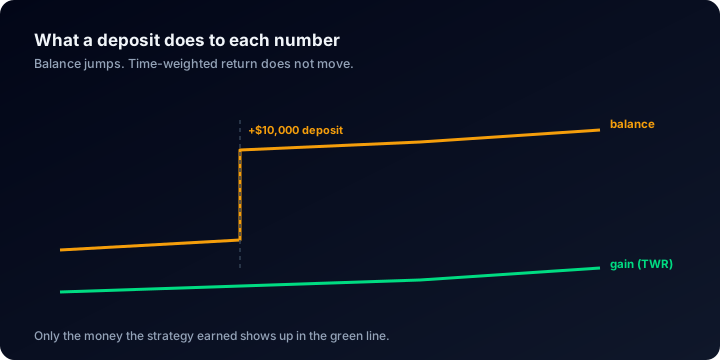
Anything built as a ratio behaves this way against a change of unit too: the currency figure moves, the percentage does not.
So read the ratios against the population, not the currency figure. Across the public accounts with trading history on ShowMyTrades, median TWR is +3.2%, 63.0% are positive, median deepest drawdown is 9.7%, median profit factor is 1.28 and median win rate is 68.8%. A cent account showing +24% with a 6% drawdown beats the median on both counts, a claim you can now check. A screenshot claiming 50,000 tells you nothing. The checklist is in how to verify trading performance claims.
🧮 Position Sizing Without Fooling Yourself
Pick one unit and stay in it for the whole calculation. Mixing them is how people end up a hundred times too large, or a hundred times too small.
Method A: work in real money. Divide the displayed balance by 100, then size normally. A 10,000 USC balance is $100; risking 1% means risking $1; with a 25-pip stop on EURUSD that is $0.04 per pip, which at $0.10 per pip per cent-lot is 0.4 lots.
Method B: work in cent units. Treat 10,000 USC as a 10,000-unit balance and use the standard formula unchanged: the contract size is already scaled for you. Same answer, fewer conversions.
The position size calculator works either way: enter the balance in the unit you intend to use and keep the pip value in that same unit. The pip calculator and margin calculator belong beside it; the full set is in the forex calculators guide.
And the leverage figure on the account header: it sets the margin you must post, not the risk you are taking. Risk is stop distance times position size; high leverage only means the broker will let you open a position larger than your stop can survive.
🧠 Why Oversized Numbers Change How You Trade
The numbers are not neutral. A loss of 500 on a screen reads as a rounding error. In real money it is $5, but on a $100 account that is 5% gone, which is a genuinely bad day by any standard.
Two distortions follow, pulling in opposite directions.
Downward, while you are on the cent account. Losses feel abstract, so stops get widened and positions averaged down. The record catches it anyway: the Z-Score flags streaky losses, and an equity line pulling away from the balance line shows held losers: both regardless of denomination.
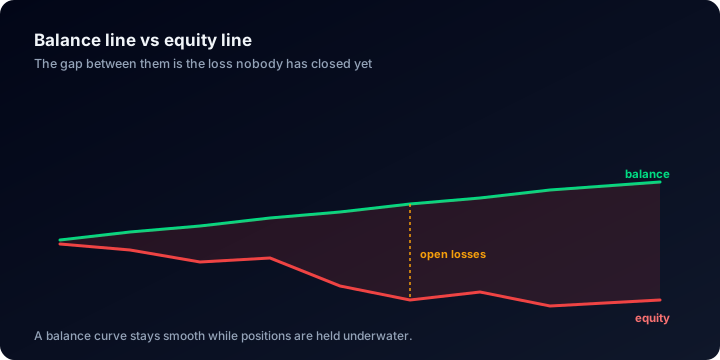
The shape is identical on a $100 cent account and a $10,000 standard one, which is why it is the first thing worth checking on either.
Upward, the day you leave. You have spent six months trading "0.5 lots" comfortably, you fund a standard account and type 0.5 again. That is one hundred times the exposure you are used to, and the first adverse move ends the account. When you graduate, recalculate every size from scratch.
The habit that protects you both ways is the same: read your own account in percentages: gain, drawdown, risk per trade. Those three behave identically on both account types. The full method is in tracking your trading performance.
🛠️ How Cent Accounts Behave Inside ShowMyTrades
A cent account connects like any other: MT4 or MT5 with a read-only investor password, cTrader through OAuth, TradeLocker with email and password. Nothing about the denomination changes the connection.
What it changes on your page:
- The account header prints the currency code beside the broker, the platform and the leverage, exactly as the broker reports them. If the badge reads USC, you can decode the rest of the page.
- Every monetary figure is formatted in that unit. A balance of 12,480 renders as
USC 12,480.00, and the six money rows of the stats panel (Balance, Equity, Highest $, Profit, Deposits, Withdrawals) carry the same code. We do not relabel a broker's figures as dollars. - The percentage modules are untouched. The KPI row (Gain, Abs. Gain, Drawdown, DD on Balance), the Monthly Returns table, the growth, balance and drawdown charts, and the ratios inside Advanced Statistics (win rate, profit factor, Sharpe, Z-Score) are quotients, and quotients ignore the unit.
- The absolute figures read in cents: Total Commissions, Total Swap Paid, Avg. Win and Avg. Loss in currency, Expectancy in currency, and the profit columns of the Currency Pair breakdown. Anything counted in pips is unaffected. Advanced Statistics holds both kinds in one panel, so read the labels, not the layout.
- The account record carries an
is_centfield, designed to divide balance and equity by 100 before the statistics are computed. The switch that would set it is not exposed in account settings today, so in practice the currency code carries the information. - The broker cost analysis in your client area already normalises. On a cent currency it divides both the money paid and the traded volume by 100 before comparing you against anything, so the estimate is not out by a factor of a hundred.
Verification is unaffected: Track Record Verified and Trading Privileges Verified are about provenance and control, not denomination. Across public accounts we currently show 65 of the first and 264 of the second.
⚠️ Five Mistakes People Make with Cent Accounts
- Reading a cent screenshot as base currency. The most common by a distance, and the reason "50,000 profit" posts travel. Check the currency code first.
- Comparing absolute profits across accounts. Currency amounts are not comparable even between two standard accounts of different sizes; between a standard and a cent account they are meaningless. Compare TWR and drawdown.
- Carrying lot sizes to a standard account. A hundredfold jump in exposure, applied by muscle memory. Recalculate from the balance, every time.
- Reading high leverage as capacity. It is permission to post less margin, not a reason to trade bigger. Stop distance and position size decide your risk; leverage decides none of it.
- Expecting a cent record to travel unchanged. A record built on $100 documents your process, not your ability to run size. Still worth publishing: a page shows the currency code and the deposit history in the open, which is the difference verified records make over a screenshot.
❓ FAQ
Is a cent account a demo account? No. It is a live account with real money, real execution and real costs. Every public page carries a Real Account or Demo Account badge, derived from the trade mode the broker reports and the server name; a funded cent account shows as Real Account.
Do I need to flag my account as a cent account for the statistics to be right? No. Every percentage metric on your page (gain, drawdown, profit factor, win rate, Sharpe, expectancy in pips) comes from ratios and is unaffected by the denomination. Only the absolute currency figures read in cents, and the currency code on your header says so.
Why does my balance show USC instead of a dollar sign? Because that is the currency your broker reports. We print the broker's code rather than substitute a symbol: relabelling USC as USD would misstate the amount by a factor of one hundred.
Are cent accounts worse for costs? Not inherently, but they are unforgiving. Spread, commission and swap scale with volume while your capital stays tiny, so the same cost structure eats a far larger share of a $100 account than of a $10,000 one. Across ShowMyTrades public accounts, 86.3% of those that pay swap pay net negative swap, a bleed felt hardest at small size.
Should I publish a cent account? Yes, if the record is honest about what it is. A twelve-month cent record with visible red months and a real drawdown is more informative than a three-month standard account with neither, and the percentages are directly comparable to every other page here.
How do I move from a cent account to a standard one safely? Keep the percentage risk identical and recompute the lot size from the new balance and the new contract size. If you risked 1% per trade before, risk 1% after; the strategy, the stop logic and the trade frequency stay as they were.
🔗 Related Guides
- How to read a trading account dashboard: every metric on a public page
- Tracking your trading performance: which numbers to watch, and why percentages win
- Verified vs unverified track records: what makes a published record trustworthy
- Verifying trading performance claims: the checklist to run before you believe a screenshot
- How to verify your account: the two badges, and how to earn them
Read a few for yourself. Explore lists public accounts with their gain and drawdown percentages; the feed prints balances with a plain dollar sign, so open a page and read the currency badge in its header. Connect your account free and yours publishes the same way: the broker's own unit, and percentages anyone can compare.
Magic Numbers: How to Separate Your Strategies Inside One Account {YEAR}
Three EAs, one equity curve, one total. Here is how magic numbers split them apart, how to label each one, and how to find the strategy quietly losing money.
Same Strategy, Two Brokers, Different Results: How to Run the Comparison {YEAR}
One strategy, two brokers, two different curves. How to run the accounts in parallel and split the gap into sizing, cost, price quality and execution latency.