The page you send buyers shouldn't sell your competitors
What actually happens when you send someone your results
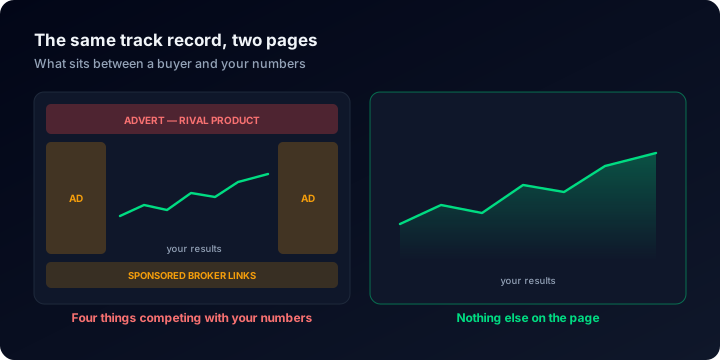
That is not a hypothetical. Open a public account page on the large tracking sites and count what sits between the visitor and the numbers: an interstitial promoting a competing robot, banners down both sides, sponsored broker links under the statistics. The tracking site is monetising the attention you earned, and it is selling it to people who compete with you.
For a trader tracking their own performance in private, none of this matters much. For anyone who sends the page to a buyer, an investor or a prop firm, it matters a great deal. Every advert is an exit door placed next to your offer.
ShowMyTrades has no advertising on it. Not fewer ads, not ads on the free plan only: none, anywhere, for anyone. That is the whole reason the page looks the way it does.
The comparison, without the sales pitch
| What you are comparing | ShowMyTrades | Myfxbook |
|---|---|---|
| Adverts next to your track record | None | Banners and interstitials, including rival products |
| Public profile and account pages | Free | Free |
| Embeddable widgets | Free, follow your site theme | Available |
| MT4 and MT5 | Yes, investor password | Yes, investor password |
| cTrader | Yes, OAuth | No |
| TradeLocker | Yes | No |
| Terminal diagnostics (ping, retransmission, DLL imports) | Yes, to the account owner | No |
| Community and forums | No | Yes, large and established |
| Economic calendar | Yes, free | Yes |
Read the community row again. Myfxbook has an audience that took years to gather and we do not. What we have is the page itself: verified, free, and empty of everything that is not your performance.
Four platforms, one read-only connection
MT4 and MT5
The investor password: it can read balance, equity and every trade, and it cannot place, modify or close an order. It is the same credential the rest of the industry uses, which is exactly why it is trustworthy.
cTrader
OAuth authorisation through the cTrader Open API, so you never hand over a password at all. You approve the connection at cTrader and can revoke it there whenever you want.
TradeLocker
Used by a growing number of brokers and prop firms, and supported nowhere else in this category. Credentials are encrypted server-side and never reach the browser.
Terminal diagnostics
For your own accounts we report the state of the terminal itself: ping to the trade server, packet retransmission, build, and whether auto trading is allowed. "40% a year" and "40% a year on a terminal with 220 ms ping" are different claims.
Follow the money and the layout explains itself
That is not a moral complaint, it is a description of an incentive. When the revenue arrives from advertisers, the page has to hold attention long enough to sell it, and the most valuable slot on the page is the one closest to the results a visitor came to read. Which is exactly where a rival product wants to be.
We took the other route: the public side costs nothing and carries nothing. Account pages, profiles and widgets are free, and the paid plan buys the Portfolio module (several accounts aggregated into one view) rather than the removal of clutter we never added. Nobody can pay us to appear beside your equity curve, because there is no slot to sell.
The practical consequence is small and specific: when you paste your link into an email, the person who opens it sees your numbers and a way to contact you. That is the entire page.
What a serious reader checks on your page
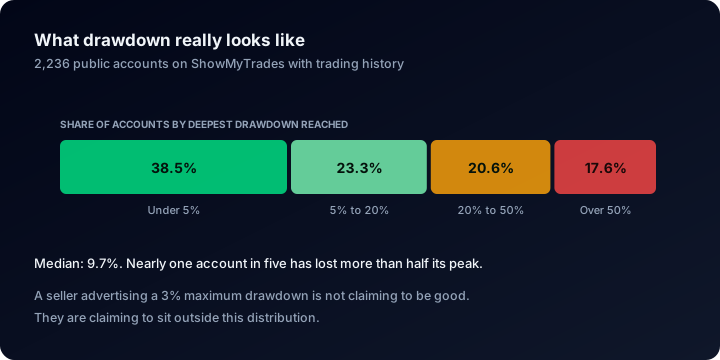
Buyers, investors and prop firm reviewers do not read a track record top to bottom. They check four things and stop if any of them fails: how deep the worst drawdown went and how long recovery took, whether losing months are present and survived, whether costs are disclosed, and how long the history actually is.
Across the public accounts on ShowMyTrades with trading history, the median deepest drawdown is 9.7%, and 38.2% have been more than 20% down at some point (August 2026). A page claiming a three-percent maximum drawdown is not describing a better trader, it is describing a shorter history or a metric measured differently. Anyone who reviews records for a living knows this, which is why hiding the number is worse than publishing an ugly one.
Our pages show both the equity drawdown and the balance drawdown, the monthly table with its red cells intact, and the commission and swap totals. If you want the reader's checklist in full, every metric on an account page goes through it module by module, and how long a track record needs to be answers the question that decides most reviews.
Verification answers two questions, not one
Track Record Verified means the numbers came from the broker through a connection that cannot write. No form, no upload, no editing after the fact.
Trading Privileges Verified means the person publishing the page proved they control the account, by performing an action only the owner could perform. Without it, a real track record can still be republished by somebody who never traded it.
Both badges sit in the page header, and the account's real or demo status is pulled from the broker rather than declared by the owner. If you want the mechanics, what third-party verification actually proves covers what each badge does and does not establish.
Moving over takes about five minutes
- Connect the account. Investor password for MetaTrader, OAuth for cTrader, broker credentials for TradeLocker.
- Let the history load. Closed trades, balance and equity arrive on their own; nothing is typed in by hand.
- Choose what is public. Private, published, or unlisted (reachable by link but absent from search and from Explore). Lot sizes, comments and stop levels can each be hidden separately.
- Take your link, or the widget. A custom slug for the page, and an embeddable widget for your own site that follows your theme instead of fighting it.
Your Myfxbook page can stay exactly where it is. Both connections are read-only and neither interferes with the other.
Questions people actually ask
Give your results a page that only sells your results
Free forever, no advertising, verified from the broker. Connect an account and see what your track record looks like without anything competing for the reader's attention.