Anyone can publish a good year. The question is who checked it
What the term is supposed to mean
A track record is the complete history of what an account did: every closed trade, the balance and equity behind them, and the drawdowns nobody enjoys mentioning. It becomes verified when that history travels from the broker to the reader through a channel the person being judged cannot write to. Nothing is typed, exported, re-saved or selected in between, and the record keeps updating whether the month went well or not.
Put like that it sounds like a technicality. It is the whole thing. Consider what an unverified record actually establishes: a screenshot proves that a screen once displayed those pixels, which is a far smaller claim than it appears to be. Any image editor changes a number in ten seconds. Twenty demo accounts can run in parallel until one of them produces a curve worth posting. A folder of statements can be filtered down to the three months that went well. None of this requires the publisher to be dishonest. It only requires the reader to have no way of telling the difference.
That is the real cost of an unverified record, and it lands on the honest trader. If a fabricated history and a genuine one look identical on screen, the genuine one is worth roughly what the fabricated one is worth. Verification exists so that people who did the work hold something the people who did not cannot copy.
None of which is our idea. Myfxbook has published read-only MetaTrader records for years, wrapped in a community and forums we have never built, and FX Blue has been doing its own version for longer still. The definition holds wherever you choose to publish. What follows is how to tell the levels apart, and what the word stops short of proving.
Four levels of evidence
| What you are checking | Screenshot | Uploaded statement | Read-only sync | Read-only sync + ownership proof |
|---|---|---|---|---|
| Where the numbers come from | An image made by the publisher | A file exported by the publisher | The broker, directly | The broker, directly |
| Can the figures be edited before you see them | Yes, with any image editor | Yes, before the file is sent | No | No |
| Losing trades can be left out | Yes | Yes | No, the whole history arrives | No, the whole history arrives |
| Keeps updating after publication | No, frozen at a chosen moment | No, frozen at export | Yes, bad weeks included | Yes, bad weeks included |
| Real or demo account | Whatever the caption says | Whatever the caption says | Read from the broker | Read from the broker |
| Proves who controlled the account | No | No | No | Yes |
| Can be republished by someone who never traded it | Yes, trivially | Yes | Yes, real data under the wrong name | No |
| Badge on a ShowMyTrades page | None | None | Track Record Verified | Track Record Verified + Trading Privileges Verified |
The jump that matters is between the second column and the third. Screenshots and statements differ in effort, not in kind: both are artefacts produced by the person who benefits from them, at a moment they chose. A read-only connection removes the choice of moment and the choice of content at the same time, which is why it is the first level that can be called evidence rather than testimony.
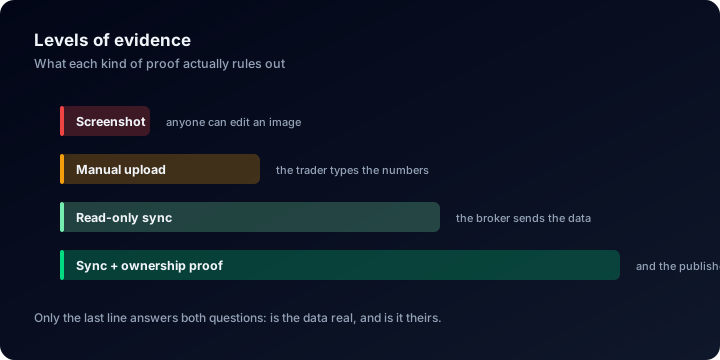
The fourth column solves a different problem, and it is the one people forget. Real data can be lifted and presented by somebody who never traded that account, so proof of ownership is a separate check rather than a formality. Verified versus unverified track records walks the same four levels with examples of what each one hides.
One badge for the data, one for the person
Track Record Verified
The data arrives from the broker through a channel that cannot place, modify or close an order. MT4 and MT5 connect with the read-only investor password, cTrader through OAuth on the cTrader Open API, TradeLocker with broker credentials encrypted server-side. Real or demo status comes down the same pipe, so it is never self-declared.
Trading Privileges Verified
The publisher proved they control the account, by doing something only a person with trading access could do. Without it, a completely genuine history can be republished under someone else's name. With it, the record and the person are tied together.
Both appear among the certifications at the top of the account page, next to whether the account is real or demo, and either can be present without the other. Plenty of real data is published by the wrong person, and plenty of genuine owners publish figures nobody ever checked.
The two counts on this site are not the same number: 65 accounts currently carry Track Record Verified and 264 carry Trading Privileges Verified. They differ precisely because the checks are independent of one another, which is the argument for having two of them rather than one. What third-party verification actually proves sets out the mechanics of each check, and how to verify your own account covers the steps from the owner's side.
What verification still does not prove
That the strategy keeps working. Verification is a statement in the past tense. A grid or martingale account can post an immaculate verified history right up to the week it meets the move it was never sized for, and every figure will have been true the entire time. Read the drawdown before the return: maximum drawdown tells you what an account has already survived, not what it can survive.
That the trader will not change it. Nothing in a verified feed prevents someone tripling their lot size next Monday. The record will show it faithfully, afterwards. Verification gives you an honest rear-view mirror, not a commitment about the road ahead.
That this is their only account. A badge covers the account it sits on and says nothing about the accounts that were never published. That is ordinary rather than sinister: 699 people here have more than one account connected and 429 trade across more than one broker. It does mean a single link is a single account, and the wider picture is a profile, not a page.
That the sample is large enough to mean anything. Four verified months of a scalping strategy and four verified months of a swing strategy are not comparable quantities of evidence. How much history a track record needs works through the arithmetic. A high win rate proves even less on its own, which is roughly why win rate is not an edge had to be written.
What to demand before you trust a published record
A live link, not an image
If the evidence is a picture or a PDF, you are looking at a moment somebody picked. Ask for the page that keeps updating. Checking a performance claim
Both badges, not one
Real data and the right owner are separate facts. Check the header for both, and read the real or demo status while you are there.
The drawdown, not the return
Returns are chosen for the pitch, drawdowns are not. Across accounts here the median deepest drawdown is 9.7%, and 38.2% have been past 20%. Reading an account dashboard
A return that survives deposits
A percentage gain means little when money moved in and out. Time-weighted return is the figure that ignores funding and shows the trading.
Costs, netted out
Spread, commission and swap decide whether an edge is an edge, and a gross figure is not one. Auditing broker costs
Robot results, read properly
Backtests and cherry-picked live runs have their own tells. Spotting fake EA results lists them, and the calculators let you redo the arithmetic yourself.
Where else a record can be published
Myfxbook takes the same investor password for MetaTrader that we do and gives away the public profile, as we do, and around it sits everything listed at the top of this page that we have never attempted: the community and the forums. FX Blue has a deep feature set and a long history behind it. Where both differ from us is concrete rather than a matter of quality. Their public account pages carry advertising (banners around the statistics, sponsored broker links, and on Myfxbook a full-screen interstitial for competing Expert Advisors) and neither reads cTrader or TradeLocker. FX Blue's embeddable widget is a white 2010-era block, which clashes with a dark site rather than matching it.
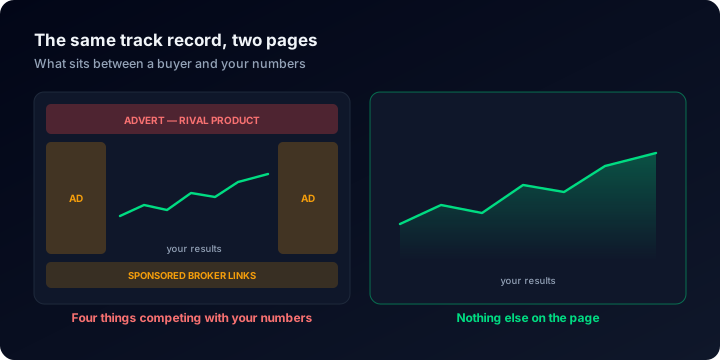
Our side of it is narrower on purpose: no advertising anywhere, on any plan, for anyone, and a free public profile, account pages and widgets that take their colours from the site you embed them in. The thing we do not have is worth repeating, because it is the reason to go elsewhere: there is no community and no forum here. If you came to be discussed and followed, this page does not answer that. Tracking trading performance covers the day-to-day side of keeping one.
Publishing one yourself
- Connect read-only. Investor password for MT4 and MT5, OAuth for cTrader, broker credentials for TradeLocker. Nothing in the system can place, modify or close an order.
- Wait rather than type. The closed trades, the balance and the equity curve are pulled from the broker and keep being pulled. Nowhere in the product can a trade be uploaded, typed in or edited afterwards, which is the point.
- Prove the account is yours. That is the second badge, and it is what stops your record being republished by somebody else.
- Decide how much of it is public. Three states: private, published, and unlisted, which answers to anyone holding the link while staying out of search results and out of Explore . Underneath that, lot sizes, trade comments and stop levels are three separate switches, so a record can be readable without giving away how it is sized.
- Share the link or the widget. A custom slug changes at most once every 30 days and the old address redirects permanently, so widgets already embedded elsewhere keep working after a rename.
Questions people actually ask
Give your numbers something a screenshot cannot give them
Connect an account read-only, prove it is yours, and publish a record that keeps updating whether the month went well or not. Free, with no advertising on it.